

Accurate jewelry valuation relies on tools that authenticate precious metals and gemstones. These instruments confirm authenticity, purity, and value using scientific principles like thermal conductivity for diamonds and elemental analysis for metals, providing immediate, dependable results. Jewelers and watchmakers use this equipment to prevent losses from counterfeits, ensure ethical sourcing, and optimize valuations. This guide covers fundamental concepts, tool categories, selection, maintenance, and frequently asked questions for diamond testers, gold purity analyzers, and complementary appraisal instruments.
What Are Gold & Gemstone Verification Tools and Why Are They Indispensable?
Gold and gemstone verification tools analyze precious materials’ composition and authenticity using physical, chemical, or spectroscopic methods. By measuring properties like electrical resistance or refractive index, they provide objective data on purity and authenticity. Advantages include minimized risk, enhanced customer trust, and adherence to regulatory standards, crucial in a market prone to fraud. Leading suppliers offer high-precision testers and support.
What Defines a Gold Purity Tester and Its Role in Verification?
Gold purity testers, either electronic devices or chemical acid kits, determine karat purity. Electronic testers apply a small electrical current, analyzing resistivity to estimate karat values quickly. Acid kits use standardized that react with the metal, producing color changes indicating fineness. Both methods offer on-site authenticity verification, using non-destructive or minimally invasive procedures.
How Do Diamond and Gemstone Testers Confirm Authenticity?
Diamond and gemstone testers confirm authenticity by evaluating unique material properties like thermal conductivity for diamonds or optical characteristics for colored stones. Thermal testers measure heat dissipation; genuine diamonds conduct heat rapidly, unlike simulants. Advanced testers use spectral analysis and UV fluorescence to differentiate natural, synthetic, and treated gems, ensuring precise identification of Moissanite, lab-grown diamonds, and colored gemstones for accurate grading and ethical sourcing.
Which Jewelry Appraisal Tools Facilitate Accurate Valuation?
Accurate jewelry appraisal uses precision scales, digital calipers, and specialized software. Milligram-accurate scales and calibrated measuring tools determine weight and thickness for karat and carat calculations. Appraisal software integrates real-time data for consistent valuation reports aligned with market trends. These tools streamline documentation, enhance transparency, and support certifications for insurance and regulatory bodies.
What Are Precious Metal Verifiers and Their Advantages?
Precious metal verifiers use X-ray fluorescence (XRF) or spectrometry for non-destructive elemental analysis of gold, silver, platinum, and palladium alloys. Handheld XRF analyzers quantify purity percentages by measuring characteristic energy emissions from energized metal atoms. Sigma Metalytics verifiers authenticate bullion and scrap using resistivity and magnetic profiling. Benefits include rapid, archival results and damage-free testing of finished pieces, essential for assay centers and workshops.
How Do Various Types of Diamond Testers Function?
Diamond testers distinguish genuine diamonds from simulants by measuring thermal or electrical conductivity, often using multi-modal techniques. Thermal testers measure heat dissipation; real diamonds conduct heat much faster than most imitations. Electrical testers assess conductivity differences between diamond, Moissanite, and cubic zirconia. Multi-testers combine both methods with UV fluorescence for comprehensive screening, helping jewelers select tools based on and accuracy.
How Does Thermal Conductivity Testing Differentiate Diamonds?
Thermal conductivity testing differentiates diamonds by measuring how quickly heat transfers from a heated probe into the stone. Genuine diamonds disperse heat in milliseconds due to high thermal conductivity, unlike most simulants. This rapid, reliable method is used for retail and field verification. Precision probe tips and sensors ensure consistent readings, minimizing false positives.
What Are Electrical Diamond Testers and Their Benefits?
Electrical diamond testers assess a stone’s electrical resistance to differentiate materials with similar thermal conductivities, especially Moissanite. Moissanite has a thermal signature similar to diamond but distinct electrical conductivity. Electrical testers provide clear pass/fail indicators with minimal calibration, offering enhanced simulant detection crucial for gemological laboratories and appraisal services.
Can Diamond Testers Identify Moissanite and Lab-Grown Diamonds?
Advanced diamond testers with thermal and electrical sensors detect Moissanite via its unique electrical conductivity. They flag lab-grown diamonds as thermally identical to natural ones, requiring further spectroscopic analysis for definitive differentiation. Specialized multi-testers use infrared absorption and UV fluorescence to distinguish CVD and HPHT synthetics. This layered approach ensures thorough screening for lab-grown variants, supporting disclosure and ethical sourcing.
What Are Multi-Testers and How Do They Compare?
Multi-testers combine thermal conductivity, electrical resistance, and optional UV fluorescence in one handheld device, screening for diamonds, Moissanite, and CZ simulants. Models vary in sensitivity and features; professional units may have interchangeable modules. Compared to single-mode testers, multi-testers offer broader coverage and streamline workflows, ideal for high-volume jewelry businesses and mobile appraisal services.
What Are the Premier Methods and Tools for Gold Purity Assessment?
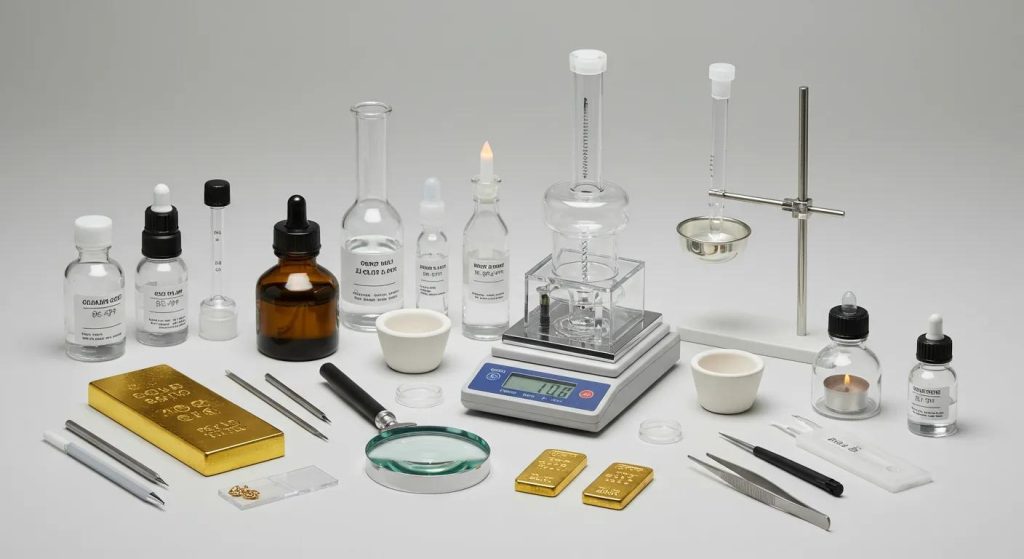
Effective gold purity assessment methods include portable electronic analyzers and laboratory-grade XRF systems, balancing accuracy, speed, and portability. Electronic testers rapidly estimate karat levels via resistivity. Acid kits offer chemical validation but require surface preparation. XRF analyzers provide non-destructive, multi-element analysis with 0.01% precision, setting the benchmark for assay houses. Specific gravity testing complements these by calculating density, useful when electronic devices are unavailable.
How Do Electronic Gold Testers Measure Karat and Purity?
Electronic gold testers measure karat levels by applying a calibrated electrical current to a metal surface and correlating the voltage drop with resistivity values from pre-programmed tables. Modern handheld units instantly display purity percentage and estimated karat values digitally. This method offers fast, repeatable results without corrosive reagents or extensive sample preparation, valued for on-site inspections, scrap evaluations, and preliminary authenticity screening.
When Is the Use of Acid Gold Testing Kits Appropriate?
Acid gold testing kits are suitable for basic karat determination and verifying vintage or plated items. Technicians scratch the metal on a testing stone, then apply standardized acid solutions that change color based on karat thresholds. Though straightforward, this method requires experienced handling to avoid inaccuracies and potential damage to delicate finishes. Jewelers typically use acid tests for secondary confirmation or when electronic testers are unavailable.
What Is XRF Analysis and Why Is It Considered the Most Accurate?
XRF analysis uses high-energy X-rays to excite metal atoms, measuring characteristic fluorescence emissions to non-destructively quantify elemental composition. This technique provides precise purity data for gold, silver, platinum, and palladium alloys, detecting trace elements down to parts per million. XRF analyzers deliver results in seconds without consumables, making them the gold standard for assay laboratories, refineries, and bullion verification due to their exceptional accuracy and speed.
How Does Specific Gravity Testing Aid in Gold Verification?
Specific gravity testing verifies gold authenticity by comparing a sample’s weight in air versus submerged in water to calculate density, which correlates with karat purity. Using a precision scale and density kit, technicians measure water displacement to derive specific gravity values, comparing them to reference charts. This non-destructive method is useful for solid items, though less precise for mixed-density alloys or hollow constructions. It supplements electronic and XRF methods when lab equipment is impractical.
Which Gemstone Identification Tools Are Essential for Jewelers?
Gemstone identification tools use optical and spectral analysis to differentiate natural gems from simulants and treated stones. Refractometers measure refractive index; polariscopes detect internal strain. Spectroscopes and dichroscopes reveal absorption bands and pleochroism for species identification. Microscopes and loupes examine inclusions and growth structures. Chelsea filters and UV lights highlight characteristic fluorescence. Together, these form an essential gemological toolkit for accurate classification and ethical sourcing verification.
How Do Refractometers and Polariscopes Assist in Gemstone Testing?
Refractometers measure a gemstone’s refractive index, identifying most transparent stones. Polariscopes use cross-polarized light to reveal internal strain and optical anisotropy, distinguishing singly from doubly refractive gems. Used together, they enable rapid on-site species identification and authenticity verification, reducing destructive testing. Their portability makes them essential for retail and field evaluations.
What Role Do Spectroscopes and Dichroscopes Play in Gemstone Analysis?
Spectroscopes reveal characteristic absorption lines and bands in gemstones, aiding differentiation between visually similar species. Dichroscopes use pleochroism to detect color variations in gems like tourmaline and sapphire. These optical devices complement refractometry by confirming chemical impurities, treatments, or synthetic origins, providing a comprehensive spectral and when combined with inclusion analysis.
How Are Gemological Microscopes and Loupes Utilized for Inclusion Examination?
Microscopes and loupes magnify internal characteristics—inclusions, growth zoning, and surface features—critical for indicating origin, treatment, and authenticity. High-magnification microscopes reveal microscopic details for expert clarity and origin evaluation. Handheld loupes allow quick field inspection of visible imperfections. Detailed inclusion analysis strengthens provenance claims and supports accurate grading, especially for high-value colored stones.
When Should Chelsea Filters and UV Lights Be Employed?
Chelsea filters selectively transmit red and green light, making certain gemstones (e.g., emeralds, rubies, synthetic spinels) appear vividly, distinguishing them from simulants. UV lights induce characteristic fluorescence in gems like diamonds and rubies, revealing treatments, fillers, or synthetic origins. Jewelers use these for rapid initial screening of fluorescent responses, complementing advanced identification instruments.
How to Select the Optimal Gold & Gemstone Verification Tools for Your Business?
Selecting testing tools requires balancing accuracy and workflow integration for professional and at-home use. Key factors include detection capabilities (e.g., thermal vs. electrical for diamonds), karat measurement precision, throughput, and portability. Professional tools offer higher accuracy, data logging, and advanced calibration; consumer kits provide basic screening. Emerging trends like AI-assisted spectral analysis, miniaturization, and ethical sourcing verification influence decisions. Businesses should evaluate operational volume and non-destructive testing needs for long-term suitability.
What Factors Should Jewelers Prioritize When Selecting Testers?
Jewelers must prioritize accuracy, detection range, ease of calibration, and sample compatibility. Accuracy impacts valuation reliability; detection range determines suitability for various gems and karat levels. Portability and power options are crucial for field use, and calibration affects maintenance. These factors must be balanced against expected throughput and the value of goods tested.
How Do Professional Tools Differ from At-Home Testing Kits?
Professional testing tools offer superior precision, automated calibration, and comprehensive data reporting, unlike basic at-home electronic or acid kits. Commercial analyzers integrate software for record-keeping, network connectivity, and multi-element analysis; consumer kits often lack digital output and require manual interpretation. Professionals gain from rigorous validation and advanced features, while hobbyists prioritize simplicity for preliminary screening.
What Are the Foremost Technological Trends in Testing Equipment?
Technological trends include AI-driven spectral analysis for automated gem identification, portable XRF with cloud data logging, and smartphone attachments for preliminary testing. Miniaturization yields compact, battery-powered analyzers for on-site assessments, and sensor advancements enhance trace element detection. These innovations streamline workflows, enable remote collaboration, and support sustainable sourcing via provenance tracking.
How Does Ethical Sourcing Impact the Selection of Testing Tools?
Ethical sourcing demands rigorous verification of gemstone and metal provenance, driving demand for tools that detect treatments, identify origin-specific inclusions, and analyze trace impurities. Spectroscopic and isotopic analysis modules offer insights into geographic origin and treatment history. Businesses prioritizing sustainability favor non-destructive methods that preserve samples and ensure compliance. Tool selection must align with CSR objectives and customer transparency expectations.
How to Maintain and Care for Your Gold & Gemstone Testing Equipment?
Proper maintenance ensures long-term accuracy, reliability, and safe operation of testing equipment. Routine calibration against certified standards is essential for diamond and gold testers. Appropriate storage (controlled humidity, clean probe tips, protective cases) prevents damage. Scheduled professional servicing addresses wear, ensures firmware updates, extends device lifespan, and safeguards assay integrity.
What Are the Recommended Practices for Calibrating Diamond and Gold Testers?
Regular calibration with manufacturer standards or certified reference materials is vital for accurate thermal probes and resistivity sensors. Technicians should follow established schedules (e.g., monthly or after temperature changes) and document all outcomes. Professional testers streamline this with calibration ports and software; consumer units require careful manual adjustment before each use.
How Should Precious Metal Verifiers Be Stored and Handled?
Precious metal verifiers, especially XRF analyzers, require storage in clean, dry environments, shielded from vibration and extreme temperatures. Protective, shock-absorbent cases prevent sensor damage during transport. Probe tips and sample chambers need cleaning with lint-free cloths and approved solvents. Proper handling, including powering down before relocation, is critical for sensor alignment and consistent accuracy.
When Is Professional Servicing Advisable?
Professional servicing is advised annually or after high-volume use for thorough inspection, seal replacement, and calibration algorithm updates. Technicians perform diagnostic checks on detectors, electronics, and mechanical parts, ensuring current firmware and software. Warranty often includes scheduled maintenance, preserving manufacturer support and minimizing downtime. Timely servicing is crucial for test accuracy and equipment lifespan.
What Are Common Inquiries Regarding Gold & Gemstone Testing Tools?
Jewelry professionals frequently ask about identifying genuine diamonds, verifying gold purity, distinguishing lab-grown from natural stones, and detecting simulants like Moissanite. Reliable answers support informed purchasing, precise appraisals, and ethical compliance. The following provides concise guidance based on established testing methodologies.
How Do Diamond Testers Function to Identify Real Diamonds?
Diamond testers identify real diamonds by measuring thermal conductivity or electrical resistance. Genuine diamonds rapidly conduct heat and show specific resistance patterns, unlike simulants. Advanced models combine both methods to minimize false positives and detect Moissanite, which requires electrical differentiation due to its similar thermal profile.
What Is the Most Accurate Method for Testing Gold Purity?
X-ray fluorescence (XRF) analysis is the most accurate method for gold purity, offering non-destructive, multi-element quantification to trace levels in seconds. Electronic resistivity testers provide reliable karat estimates for common alloys. Acid kits serve as quick secondary checks when lab instruments are unavailable.
Can Diamond Testers Differentiate Lab-Grown from Natural Diamonds?
Basic diamond testers cannot differentiate lab-grown from natural diamonds due to identical thermal and electrical properties. Specialized spectroscopic devices and advanced multi-testers with UV and infrared modules are needed to detect unique growth patterns of CVD and HPHT synthetics.
Which Tools Are Optimal for Testing Moissanite and Other Simulants?
Multi-testers combining thermal conductivity, electrical resistance, and optional spectroscopic sensors are optimal for testing Moissanite and other simulants. They distinguish overlapping properties and flag inconclusive results for further analysis. Handheld electronic testers with dual-mode detection offer efficient screening for mixed inventories.
How Can Jewelers Leverage Testing Tools to Enhance Appraisal Accuracy?
Jewelers enhance appraisal accuracy through systematic testing workflows: starting with non-destructive XRF or thermal assessments, followed by optical inspections and specific gravity checks. Documenting results in appraisal software creates comprehensive records. This layered approach minimizes errors, supports consistent reporting, and builds customer trust.
Reliable testing tools and disciplined workflows are fundamental to professional jewelry valuation, fostering trust, ensuring compliance, and streamlining operations for jewelers and watchmakers.